Trust or trustees as shareholders
Can a trust or trustees be a shareholder of a company?
In short, yes. However, under s.126 of the Companies Act 2006, a company registered in England, Wales or Northern Ireland must not state in the company registers – or in the information filed at Companies House – that shares are held by or on behalf of a trust. This restriction does not apply to Scottish-registered companies.
There are also differences in the ways that trusts and trustees can hold shares. Generally speaking, trustees can be legal owners of the shares – i.e. hold the legal title – if they are individuals or corporates with legal personality. You would therefore register them as joint shareholders of the shares in question. For more information on joint shareholders, see here.
However, if a trust does not have legal personality, it can only have beneficial ownership over the shares. In this situation, you would register one or more of the trustees as the legal owner(s) as above.
For more information about recording beneficial ownership in Kudocs, including UBO registers, see here.
Do I need to show that a trust/ trustee is a shareholder of a company?
No. In fact you are not allowed to do this, unless the company is registered in Scotland.
For companies registered in England, Wales or Northern Ireland – if the shares are held by a trust, you should record the trustee(s) in the registers as the shareholder(s) as explained above. You must not make any mention of the trust in the main register entry, or that the shareholders are holding the shares as trustees. If there are multiple trustees, you can add them as joint shareholders (with the shareholder who is named first usually being the ‘senior member‘ for voting and shareholder communications).
You can, however, add details of the trust to a Kudocs stakeholder record to explain that shares are being held on behalf of beneficiaries. This could either be named individuals or a trust. This information is ‘Kudocs only’ – it will not appear in any company registers or Companies House filings, but is available for internal reference in Kudocs. Note that this is a different process to adding details of joint (legal) shareholders.
How do I record the details of shares being held on behalf of someone else (e.g. in a trust) in Kudocs?
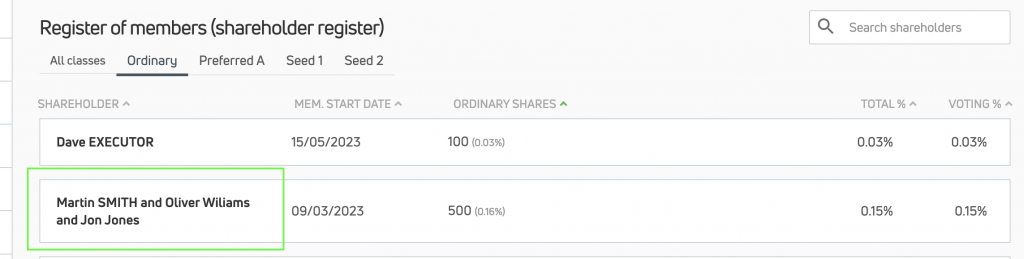
As explained above, you should record the details of the people holding the legal title to the shares (i.e. the trustees) as the shareholders for the register of members. You can then add the beneficiary details for internal Kudocs reference only.
As an example – if the ‘Smith Trust’ owns shares, you may not name the Smith Trust as a shareholder in the register of members or in your reporting to Companies House. Instead, you should list the trustees of the Smith Trust as the legal (joint) owners of the shares. Their details will appear in the register of members and at Companies House as (say) ‘Martin Smith and Oliver Williams and Jon Jones’.
You would then use Kudocs to record – as ‘Kudocs-only’ information – that these shares are held as trustees for the Smith Trust. You can also add any further details of the (known) beneficiaries or important notes about the trust that you want other Kudocs users to know. If the same trustees hold shares for multiple trusts or beneficiaries (e.g. the Smith Discretionary Settlement No. 1 and the Smith Discretionary Settlement No. 2), you can specify how many shares or what % of the total shareholding is allocated to each beneficial owner or trust.
If I want to export the registers for review, how can I include the details of shares being held in a trust?
You can export this information as a separate register of Beneficial Ownership. See here for more details.
Can I use Kudocs to incorporate a new company with a trustee as a shareholder?
Yes you can, subject to the points above. For example, you cannot show that the trustee is holding the subscriber share(s) on trust, unless it is a Scottish company.
One complication is that there are often multiple trustees – in other words, joint shareholders. Companies House generally does not like incorporation applications where there are joint shareholders (e.g. if you have multiple trustees for 1 shareholding). For more information on incorporating a company with joint shareholders, see here or get in touch with us.
How do I add details of joint trustee shareholders and beneficiaries during onboarding?
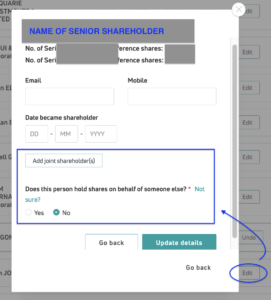
It is easy to do this using Full Onboarding. Just click ‘Edit’ next to the senior shareholder’s name and then add details of the joint shareholders and/or any beneficiaries. The joint shareholding will be added to the registers in Kudocs and any Companies House filings, but the beneficiary information will only be available inside Kudocs.
Don’t panic if you miss adding this information straight away, or if you complete Quick Onboarding (where you cannot edit shareholding information). You can always add joint or beneficial owner information by editing the relevant stakeholder record after onboarding.
What about PSCs (People of Significant Control)?
For more information on PSCs, see our main FAQ here!
In short – as a trust will generally not have legal personality, they will probably also fail the criteria for being a PSC or a relevant legal entity (RLE). However, you must still assess whether the trustees meet the PSC conditions (including as a group if they are joint shareholders). You must also assess whether any individuals hold ‘significant influence or control’ over the trustees/trust. Some points to check:
- Does the ‘trust shareholding’ – the block of shares held by the trustees on behalf of the trust – trigger any PSC conditions? For example, if Martin Smith, Oliver Williams and Jon Jones jointly own over 25% of the shares in a company on behalf of the Smith Trust, they might each be considered an individual PSC holding over 25% of the shares under PSC condition (i) (following the PSC ‘logic’ for joint shareholders). Similar logic should be followed for PSC conditions (ii) and (iii). This all depends on the nature of the trust.
- Is there any individual who holds ‘significant influence or control’ over the trustees of the ‘trust shareholding’, as assessed against the Companies House statutory guidance? If so, they will likely be considered an individual PSC under PSC condition (v) – which is much rarer!
Assessing PSCs for ownership structures involving trusts can get very complicated, so you should take care to read the Companies House guidance in full. You may need to take professional advice for your situation.
Last updated: 19/02/2026 by Kudocs Admin