Why does Kudocs require recent transactions to be added in chronological order?
This note explains why it is important to add recent transactions to Kudocs in chronological order (and why Kudocs prevents you from adding certain recent transactions that pre-date others. You do not need to worry about this when adding historic transactions.
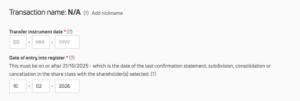
Kudocs recalculates share balances after each transaction is added to the system to ensure that shareholders, shareholdings, share capital and share certificates (if generated) are always correct as at the date of that transaction. If you try to add share transactions out of order, the calculations may not be correct. Kudocs works a bit like a bank account in this respect – transactions need to be recorded in real time to ensure that the balance after each transaction is correct to allow the subsequent transactions to make sense.
Example 1:
- Company issues 100 ordinary shares to A on 1 January.
- B transfers 500 shares to A on 1 February, so A now has 600 ordinary shares.
- A transfers 400 shares to C on 1 March.
All of these transactions are recorded in Kudocs on the same day.
If you try to record the transfer of -400 shares A > C before the transfer of +500 B > A the system will prevent you as A does not have enough shares to transfer. You need to add the transactions in the correct chronological order so that the total shareholdings are correct.
Kudocs works a bit like a bank account in this respect – transactions need to be recorded in real time to ensure that the balance after each transaction is correct to allow the subsequent transactions to make sense. E.g. f you have £100 in your account and are being paid £300 and need to pay someone £400, you cannot make the payment out until you have received the money in – as you need to have the correct balance.
Example 2:
- A starts with 100 shares.
- B starts with 5 shares.
- A transfers 25 shares to B on 1 July.
- These transactions are recorded in Kudocs on the same day in August. Kudocs calculates the individual totals so that A has 75 shares and B has 30 shares.
If a few days later you were to record a subdivision of shares (100 > 1,000) that happened in June (ie that pre-dated the transfer that you have already recorded), the system would be required to decide whether the 25 shares that were transferred in July should be left as 25 or retrospectively subdivided: does A now have 750 (1,000 – 250) or 975 (1,000 – 25) shares? etc. Kudocs cannot determine that, which is why it is important that you add transactions to Kudocs in chronological order.
If it helps to think of it like a bank (and we know this is not how banks work, but if they did…): on 1st of the month you have £100. You pay out £60 on 20th. But you can’t then go back to the bank and say that you also paid out £80 on 10th – because that would mean you did not have enough money on 20th to pay £60.
Kudocs is similar in that it works on a live balance basis.
Last updated: 22/05/2026 by Kudocs Admin